

If you’ve been taking antidepressants for months or even years without feeling better, you’re not alone. You’ve probably wondered why the medications that help so many others just don’t seem to work for you.
The truth is, depression isn’t a one-size-fits-all condition, and neither is treatment. For some people, traditional antidepressants simply aren’t enough. That’s where Spravato comes in — a treatment with a completely different Spravato mechanism of action than anything you may have tried before.At REACH Behavioral Health, we offer Spravato as part of our depression treatment in Ohio because we’ve seen what a difference it can make. But what does the Spravato experience actually feel like when it starts working? Let’s break it down.
Why SSRIs, SNRIs, and tricyclics don’t work for everyone
If you’ve been diagnosed with depression, chances are you’ve tried medications like Zoloft, Lexapro, Cymbalta or Effexor. These are all common antidepressants that fall into categories called selective serotonin reuptake inhibitors and serotonin-norepinephrine reuptake inhibitors. Older medications called tricyclic antidepressants work in similar ways.
All of these medications target the same basic system in your brain. They increase levels of chemical messengers, called neurotransmitters, such as serotonin and norepinephrine. The idea is that boosting these chemicals will improve your mood. For many people, this approach works. But here’s the thing: Depression isn’t always about serotonin.
Depression is complex, and it can involve multiple factors, including disrupted communication between different brain regions, inflammation, and even structural changes in the brain that no amount of serotonin adjustment will fix. For some people, the underlying problem isn’t related to the systems that traditional antidepressants target.
This is why roughly 60% of people with depression don’t experience adequate relief from their first antidepressant. When you try two or more medications without success, doctors call this treatment-resistant depression.
If you’ve found yourself in this frustrating cycle of trying medication after medication without lasting improvement, it doesn’t mean you can’t be helped or that your depression symptoms are a permanent part of life. It may mean you need a treatment that approaches depression from an entirely different angle.
How Spravato works: A different kind of antidepressant
Spravato (the brand name for esketamine) is fundamentally different from traditional antidepressants. While SSRIs and SNRIs focus on serotonin and norepinephrine, Spravato nasal spray targets an entirely different brain system: the glutamate pathway.
Glutamate is actually the most abundant chemical messenger in your brain, and it plays a crucial role in learning, memory and mood regulation. Research has shown that people with depression often have disrupted glutamate signaling in key brain regions. Take a look at how the Spravato mechanism of action works at the brain level.
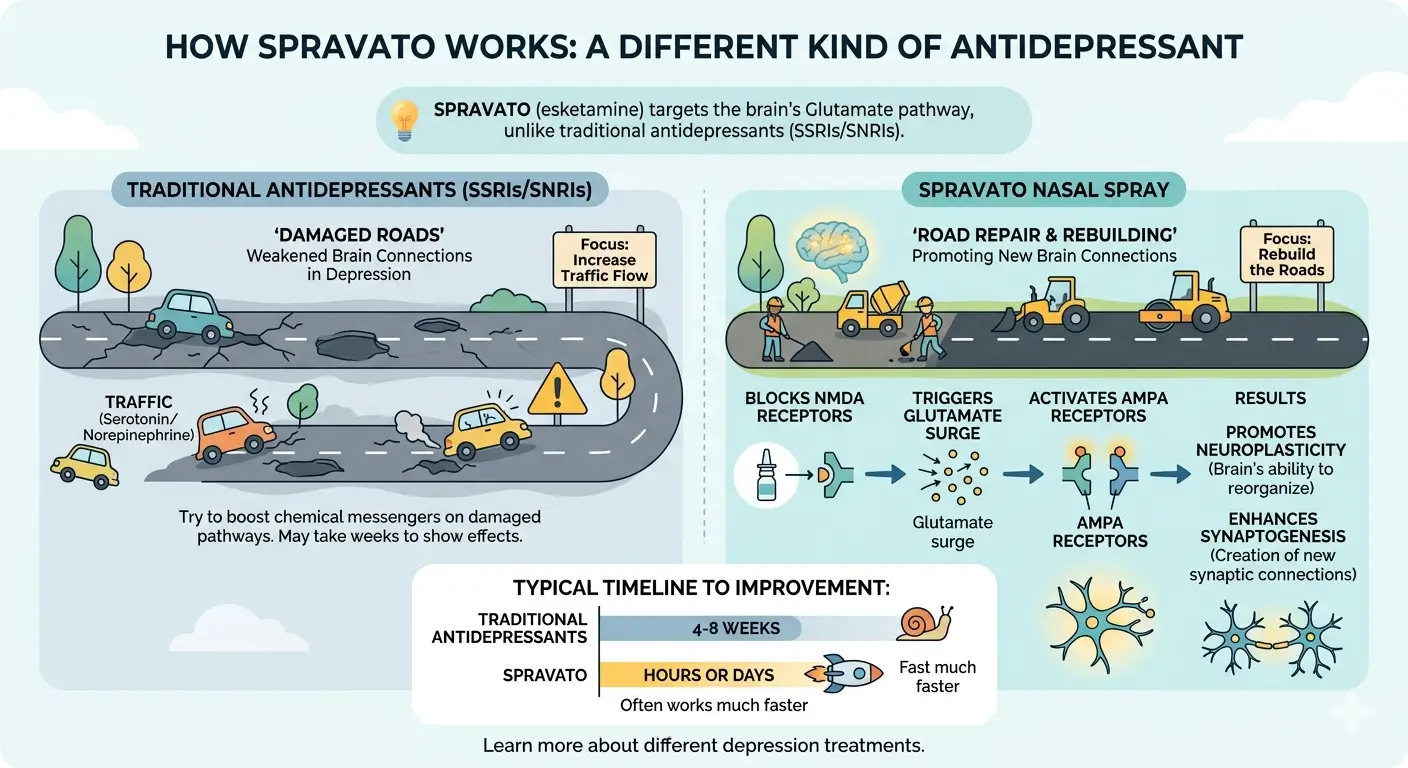
Spravato temporarily blocks certain receptors in your brain called NMDA receptors. This brief interruption triggers a surge in glutamate activity, which then activates other receptors, called AMPA receptors (NMDA=N-methyl-D-aspartate). This chain reaction does something remarkable: It promotes the growth of new connections between brain cells and helps restore healthy communication patterns in areas of the brain affected by depression.
In scientific terms, Spravato promotes synaptogenesis (the creation of new synaptic connections) and enhances neuroplasticity, which is your brain’s ability to change and reorganize based on what you experience and practice.
Think of it this way: Depression can weaken the internal communication network in your brain over time, like roads falling into disrepair. Traditional antidepressants try to increase traffic on those damaged roads. Spravato, on the other hand, helps rebuild the roads themselves.
This is also why Spravato often works much faster than traditional antidepressants. While SSRIs and SNRIs typically take four to eight weeks to show effects, many people notice meaningful improvement within hours or days of their first Spravato treatment.
Learn more about what ketamine can treat and how it differs from other depression treatments.
What “rewiring” actually feels like
When we talk about Spravato promoting neuroplasticity, we’re essentially saying it helps your brain rewire itself. But what does the Spravato experience feel like?
Rewiring doesn’t usually feel like a dramatic breakthrough or a sudden switch flipping. The process is much subtler and, in many ways, more powerful.
Step 1: Interrupting the pattern
With depression, certain thought patterns become automatic. You might have a thought like “I’m a failure” pop up dozens of times a day without even noticing it consciously. These thoughts run on autopilot, because the neural pathways associated with them have become deeply worn, like a groove in a record.
During and after Spravato treatment, many people describe being able to notice these thoughts rather than being consumed by them. You might catch yourself thinking, “I’m having that ‘I’m a failure’ thought again,” instead of simply believing it as the absolute truth. This awareness — being able to step back and observe a thought rather than being swept away by it — is actually the first small rewiring moment. When you become aware of an automatic pattern, you’re already weakening its grip on you.
Step 2: Introducing a new pathway
Once you notice a negative thought pattern, you have the opportunity to do something different. Instead of arguing with the thought or spiraling into self-criticism, you might try asking yourself something simple: “What’s one small thing I did OK today?”
At first, this will probably feel forced or even fake. You’re essentially trying to walk down a new path through overgrown brush, while there’s a well-paved highway right next to it. Naturally, the new path feels harder.
However, here’s where Spravato’s effect on neuroplasticity becomes important: It makes your brain more receptive to forming new pathways.
Step 3: Repetition is the rewiring
Real change comes through repetition. Every time you notice the old thought pattern (“I’m a failure”) and consciously shift toward looking for evidence of small wins, you’re strengthening the new pathway and letting the old one fade.
Over time, your brain starts choosing the new path more easily. The old pattern doesn’t disappear entirely, but it becomes less dominant, less automatic and less overwhelming. The key thing to understand is that rewiring doesn’t usually feel like a dramatic moment of healing. Instead, it feels like having a little more room to respond differently. It feels like the negative thoughts are still there, but they’re not quite as loud and not quite as convincing.
Is Spravato right for you?
You may be a good candidate for Spravato if you:
- Have tried at least two different antidepressants without adequate improvement.
- Are currently experiencing severe depression or suicidal thoughts.
- Are over 18 years old and don’t have certain medical conditions that would make the treatment unsafe for you.
- Are willing to receive treatment in a clinical setting.
- Understand that Spravato works best as part of a comprehensive treatment plan.
If you’ve been struggling with depression that hasn’t responded to other treatments, the most important first step is having a conversation with a psychiatrist or behavioral health team who can evaluate your specific situation.
Getting Spravato treatment in Ohio
At REACH Behavioral Health, we’ve seen firsthand how transformative Spravato can be for people who had nearly lost hope after years of trying medications that didn’t work. Our approach combines Spravato treatment with comprehensive psychiatric care and therapy support, because we know that real, lasting improvement comes from addressing depression from multiple angles, not just with medication alone.
If you’re curious about whether Spravato might be right for you, we’re here to answer your questions and help you understand your options.
Here’s what you can expect:
- We’ll start with a thorough initial consultation where we’ll review your treatment history, discuss your current symptoms, and determine if you’re a good candidate for Spravato. We’ll also verify your insurance coverage, as Spravato is FDA-approved and often covered for qualifying patients.
- If you move forward with treatment, you’ll receive Spravato in our comfortable Westpark, Ohio, clinic under careful medical supervision. Treatment schedules vary but typically involve twice-weekly sessions for the first month, followed by weekly or biweekly sessions as you continue to improve.
- Throughout your treatment, we’ll work with you to build the additional supports, whether that’s talk therapy, lifestyle changes or other interventions that help make the improvements from Spravato as lasting as possible.
Take the first step toward a different kind of relief
If you’ve been struggling with depression that doesn’t respond to traditional treatment, you don’t have to keep trying the same approaches and hoping for different results.
Spravato offers a genuinely different mechanism of action — one that targets your brain’s ability to form new connections and gives you more room to break free from the thought patterns that keep you stuck.
Contact REACH Behavioral Health today to schedule a free consultation and find out if Spravato treatment could be the breakthrough you’ve been waiting for.