

If you’ve been wondering what esketamine therapy is like – what you’ll feel, what happens in the room, and whether it’s right for you – you’re not alone. It’s completely natural to have questions about a treatment that’s different from anything you may have tried before.
This guide walks you through every step of the experience, so you can walk into your first appointment at REACH feeling informed and at ease.
Spravato esketamine therapy is an FDA-approved treatment for adults with treatment-resistant depression (TRD) who haven’t found relief from standard antidepressants. Unlike a typical prescription you take at home, each session is administered and monitored in our accredited REACH Cleveland – Westpark clinic, with a clinical team by your side from the moment you arrive to the moment you leave.
| Note: Spravato esketamine therapy is available exclusively at the REACH Westpark clinic.
How does Esketamine therapy work to treat treatment-resistant depression (TRD)?
You may already know that traditional antidepressants work by increasing serotonin and norepinephrine – two neurotransmitters that regulate mood, sleep, and anxiety. For many people, this works well. But for those whose depression isn’t primarily driven by those pathways, standard antidepressants may never fully help.
That’s where esketamine comes in. It works on a completely different system in the brain – the glutamate system – which is thought to play a key role in mood regulation, memory, and cognitive function. By targeting glutamate receptors, esketamine can offer faster, meaningful relief for people who have tried and not responded to other treatments. If you’d like to go deeper we explain exactly how in Spravato mechanism of action:how it rewires negative thought patterns in depression.
What is the difference between Ketamine and Esketamine?
People often hear the terms ketamine and esketamine used together, but they have differences you should know about. Spravato contains esketamine, which has been approved by the FDA for depression treatment.
Although used for decades as an anesthetic, ketamine may help treat depression as an off-label prescription, usually through intravenous infusion. Alternately, esketamine is administered as a nasal spray, not as an IV.
While the two are related chemically, Spravato is its own treatment with its own process, monitoring requirements, and FDA approval.
Who should consider Esketamine treatment?
Esketamine treatment may help people who have tried more than one medication and still suffer from persistent depression symptoms. It can also be considered when depression continues to interfere with daily life even after therapy, medication, or both.
Some people turn to Spravato after years of searching for the right combination of care. Others come to it after reaching a point where symptoms have become harder to ignore, whether that means difficulty getting through the day, trouble following through on responsibilities, or feeling like nothing has changed despite repeated attempts at treatment.
Scheduling a consultation at REACH for depression treatment in Ohio begins the process of determining whether Spravato is right for your unique mental and emotional needs.
What happens before your first Esketamine session?
Initial consultation
Your journey begins with a one-to-one assessment with a REACH provider. This is a relaxed, thorough conversation – not a test. Your provider will:
- Conduct a full psychiatric and medical assessment
- Ask questions about your treatment history
- Confirm your eligibility for treatment-resistant depression therapy
Scheduling and insurance review
Once your eligibility is confirmed, our team takes care of the logistics so you don’t have to. We’ll:
- Schedule your induction series at a time that works around your life
- Help with insurance authorisation or provide transparent out-of-pocket estimates
- Plan appointments around your schedule at our REACH Westpark clinic
Pre-treatment guidelines
Before each session, there are a few simple things to keep in mind:
- Avoid eating for at least 2 hours before your appointment.
- Avoid drinking anything for 30 minutes before you arrive.
- Arrange for someone to drive you home – you won’t be able to drive yourself after treatment.
- Give yourself the rest of the day. Plan to take it easy afterward rather than heading straight back to work or exercise.
What happens during esketamine therapy?
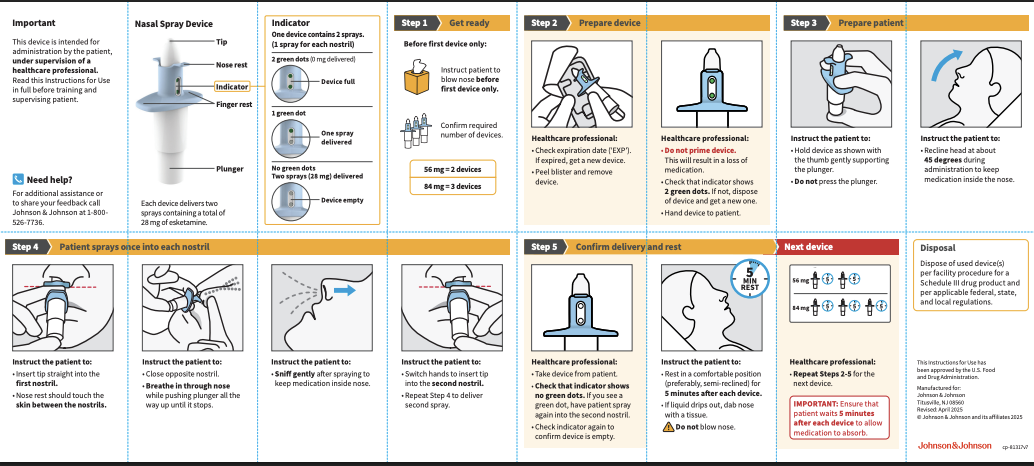
When you’re settled in, you’ll self-administer the Spravato nasal spray under the guidance of your clinical team. Doses are typically divided into 2 to 3 sprays per nostril. You won’t be doing this alone – we walk you through every step and stay with you throughout.
Your psychiatrist determines the right dose for you based on your symptoms, response, and overall health. A higher dose doesn’t necessarily mean better results – it’s about finding the most effective and comfortable balance for each person.
So, what does esketamine therapy actually feel like?
Within minutes of the first spray, many patients describe a gentle sense of weightlessness – as though the weight they’ve been carrying has temporarily lifted. You may notice that sounds or lights seem slightly different than usual; this is a mild, brief perceptual shift (not a hallucination), and it’s completely expected.
Some people feel mildly drowsy, as if they’re drifting toward the edge of sleep – though you’ll remain fully awake and able to talk with our team throughout. The whole experience is intentionally calm and supervised. You are never left alone.
These sensations typically peak around 40–45 minutes after administration and gradually fade within 2 hours for most patients.
Esketamine side effects: What is normal and what to expect
Like any medication, Spravato can cause side effects. The most common ones start soon after the spray and fade the same day. Your care team watches for them during every session
- Dissociation: A temporary feeling of being gently detached from your surroundings. It can feel a little unusual if you haven’t experienced it before, but it’s not distressing for most patients and fades within 1–2 hours.
- Dizziness or lightheadedness: Most common in the first few minutes after administration and usually settles quickly.
- Drowsiness or sedation: This is why having a designated driver is non-negotiable. You’ll feel more like yourself by the following morning.
- Elevated blood pressure: Your blood pressure and heart rate are checked before and after every session as a standard part of your care.
- Nausea: Mild and short-lived for most people. Let your nurse know if you’re feeling uncomfortable – we can help.
Serious risks you should know about
The effects listed above usually fade within about 2 hours. But Spravato also carries a boxed warning. This is the FDA’s strongest type of warning, and it covers:
- Sedation You may feel very sleepy or detached during a session.
- Slowed or shallow breathing (respiratory depression). This is rare, but it is one reason we check you throughout the session.
- Misuse and dependence. Esketamine can be misused, so it is only given in a certified clinic, never at home.
- Suicidal thoughts. As with other antidepressants, people under 25 may have a higher risk of suicidal thoughts, especially early in treatment or after a dose change.
Because of these risks, Spravato is only available through a restricted FDA program called REMS. Certified clinics like REACH Westpark monitors you for at least 2 hours after each dose. Tell your provider right away about any new or worsening mood changes, including between sessions.
Read more about Spravato side effects and who should not take it
After your Esketamine session
Before you leave the clinic, a member of your care team will check in with you – assessing your alertness and vital signs to make sure you’re stable and feeling ready to head home safely. There’s no rush.
Because residual drowsiness can linger for a few hours after your session, please make sure your designated driver is ready to take you home. For the rest of the day, we’d encourage you to keep things low-key – rest, take it easy, and avoid driving, operating machinery, or making any big decisions until the following morning.
For most patients, any lingering fogginess or fatigue resolves fully within 24 hours, and you’ll be back to your normal routine by the next day. If anything feels off once you’re home, our clinical team is available and happy to answer your questions.
How many Esketamine therapy appointments will I need?
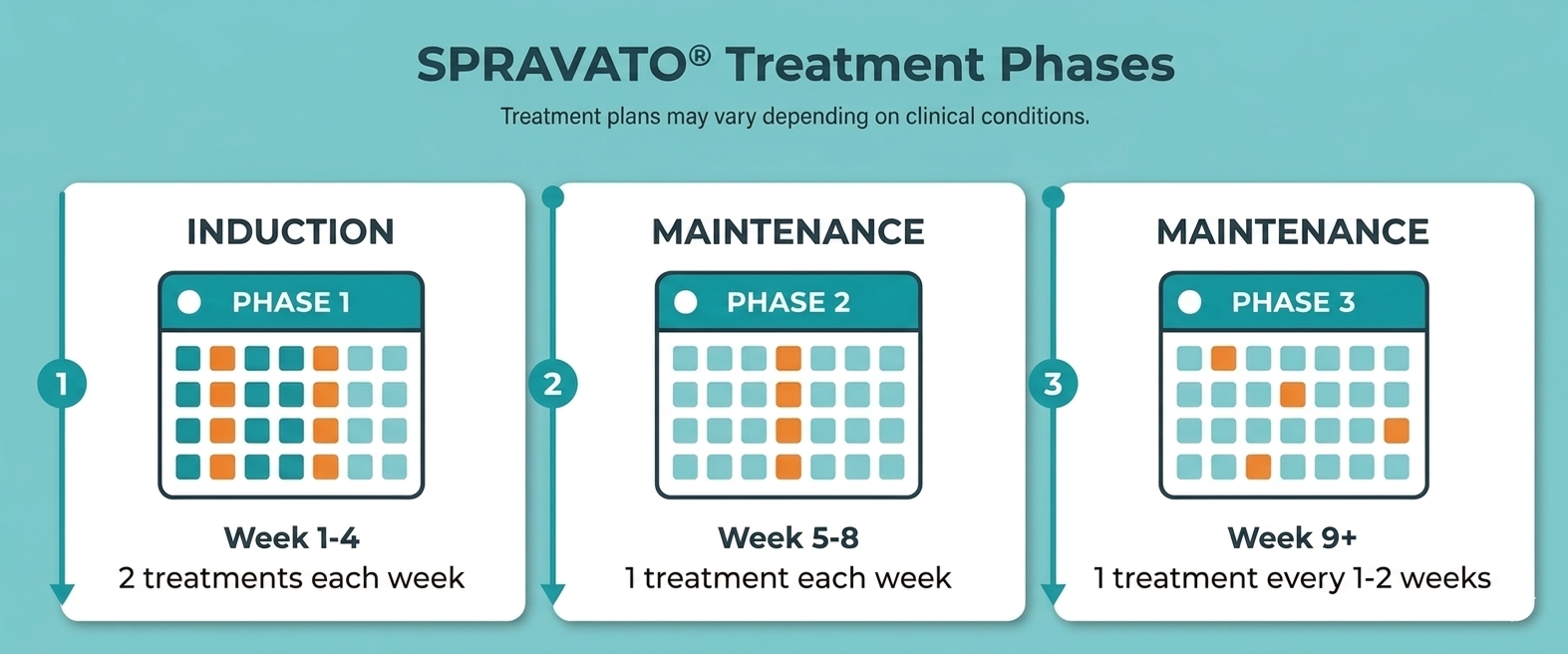
Treatment is structured in three phases, and your schedule is adjusted over time based on how you’re responding:
Induction phase (Weeks 1-4)
Two sessions per week for the first four weeks. The goal here is to begin stabilising your mood and giving you meaningful symptom relief.
Optimization phase (Weeks 5-8)
As symptoms improve, sessions typically reduce to once per week. This phase is about building on the progress you’ve made.
Maintenance Phase (Beyond Week 8)
Depending on your individual response and your provider’s guidance, you may move to a session every one to two weeks. Your progress is reviewed regularly, and your schedule is adjusted based on how you’re feeling.
Follow-Up Care
Many patients continue maintenance sessions for several months alongside a stable oral antidepressant. Periodic psychiatric evaluations help your team determine:
- Whether ongoing sessions are still beneficial
- Whether the frequency can be reduced
- When, if appropriate, it’s time to transition off treatment
Combining esketamine therapy with psychotherapy or counselling can also support lasting results – helping you process emotions and build healthy patterns alongside the biological relief the treatment provides.
Why choose REACH for Esketamine therapy
Choosing where to receive esketamine therapy is an important decision, and we want you to feel completely confident in your care. At REACH Westpark, you’ll find:
- An accredited, REMS-certified facility specifically approved for Spravato administration.
- A multidisciplinary clinical team that brings together psychiatry, nursing, and therapy under one roof.
- Individualised dosing with careful monitoring and coordination at every stage of your treatment.
- Seamless collaboration between your outpatient therapy and medication management.
From your pre-dose screening through to your post-session recovery, our priority is your comfort, safety, and long-term wellbeing – not just the treatment itself.
FAQ about esketamine therapy
- How long is each esketamine therapy session?
Each appointment at our REACH Westpark clinic typically lasts 2 to 3 hours, covering preparation, administration, and a monitored observation period before you head home.
- Can I drive after esketamine treatment?
No. You must arrange for a designated driver. You should not drive, operate machinery, or make critical decisions for at least 24 hours after your Spravato session.
- Will I be unconscious during esketamine therapy?
Most people stay awake and can talk with the care team. Some feel very drowsy. This is why a staff member monitors you for the whole session.
For most adults with treatment-resistant depression, Spravato is well tolerated when it is given in a certified clinic with monitoring. It is not risk-free. It carries a boxed warning for sedation, dissociation, breathing problems, misuse, and suicidal thoughts in younger patients. Your provider will review your health history with you to decide if it is a safe option for you. See the full list of side effects and risks.
- How many esketamine treatments will I need?
Most patients start with two sessions per week during the four-week induction phase, then move to once weekly, and eventually once every one to two weeks for long-term maintenance. Your provider will personalise your schedule based on how you’re responding.
Taking the next step toward reclaiming your life
If you’ve been living with major depression and haven’t found relief with oral antidepressants, you deserve to know that there are other options – and you don’t have to keep waiting to feel better.
Esketamine therapy at REACH Westpark offers a faster, clinically supervised path toward real, meaningful symptom relief. The first step is simply a conversation.
Contact REACH today to schedule your consultation and find out whether Spravato Esketamine therapy is right for you. We’re here whenever you’re ready.