
If you or your child are showing traits of autism, getting the right evaluation can make all the difference.
An official autism diagnosis opens the door to support, resources, and next steps – but knowing where to start can often feel confusing or overwhelming.
One of the most effective and widely used tools in autism evaluations is the ADOS assessment, which we provide as part of our comprehensive autism-related services at REACH BH. In this guide, we’ll briefly explain what ADOS testing is, before covering all the most common questions we are asked about ADOS assessments – from what it measures and how it helps, to what to expect, and how to arrange an ADOS test for autism for you or your family.
What is ADOS testing? A simple explanation
ADOS-2 stands for Autism Diagnostic Observation Schedule (2nd edition).
It’s one of the most widely used tools for diagnosing autism in people of all ages, from toddlers through to adults.
An ADOS assessment is a face-to-face, activity-based session where a trained clinician carefully observes how someone communicates, interacts, and responds during simple activities, play, or conversation.
It’s relaxed, interactive, and designed to feel natural – and there are no right or wrong answers. It isn’t a test you pass or fail, but a structured way for clinicians to observe and measure autism-related traits in real time.
It’s not a standalone diagnostic test – it’s one part of a full autism evaluation and helps inform the final diagnosis. But it’s often considered one of the most valuable parts of the process.
The ADOS-2 is considered the gold standard in autism testing because it’s:
- Comprehensive in observing behaviors associated with autism
- Research-based and highly standardized
- Consistent and reliable across different evaluators
- Useful and accurate for both children and adults
- Helpful for identifying subtle social or communication differences
Common questions about ADOS assessments
What does ADOS stand for?
ADOS stands for Autism Diagnostic Observation Schedule.
It sounds complex, but the idea is simple: It simply means observing specific behaviours and responses in a structured way – to help diagnose autism.
What’s the difference between ADOS and ADOS-2?
ADOS was the original version of the assessment.
ADOS-2 is the latest version, which has been updated and improved for accuracy, to align with current diagnostic criteria, and to include a broader age range.
Almost all clinics (including REACH) now use ADOS-2 as standard, although it’s still commonly referred to simply as “ADOS.”
If you’re scheduled for an ADOS in the U.S., it’s almost certainly the ADOS-2.
What does the ADOS measure?
The ADOS looks at key traits and areas of development that are often linked to autism.
It helps answer the question: “Do this person’s behaviors align with common signs of autism – and if so, how strongly?”
It looks at things like:
- Communication and language skills
- Social interaction
- Play skills or imagination (in children)
- Repetitive behaviors or highly focused interests
- Social or emotional responses
Who is the ADOS for? Children, teens, or adults?
The ADOS is designed for anyone displaying traits of autism, at any age – from toddlers (2+ years) through to adults.
There are different “modules” of the assessment, each designed to suit different ages and abilities.
What happens during an ADOS assessment?
ADOS assessments vary slightly depending on age and abilities, but they’re always interactive, low-pressure, and designed to be enjoyable – not clinical.
- For children, it’s usually fun – playing games and engaging in age-suitable activities.
- For teens and adults, it’s more like a guided conversation – but also enjoyable, involving simple games, fun problem-solving tasks, storytelling, and conversation.
Whatever the age, the goal is the same: to create a relaxed environment where the person being assessed can be themselves.
During the assessment, the clinician quietly notes specific behaviors according to a standardized scoring system, which helps inform their final evaluation.
How long does an ADOS test take?
Most ADOS assessments take 40 minutes to one hour.
Does the ADOS diagnose autism on its own?
No – the ADOS helps inform an autism diagnosis, but it’s never used as a standalone diagnostic tool.
Clinicians combine ADOS results with other important information, such as:
- Developmental and medical history
- Interviews or questionnaires
- Everyday behavior patterns
- Strengths and challenges
- Additional assessments, if needed
ADOS is one of the most effective and important tools, but it’s part of a full autism evaluation, not the whole process.
How are ADOS results used?
After the ADOS assessment, the clinician scores the observed behaviors using a standardized system. The score indicates how closely each behavior aligns with autism-related traits.
These results are then combined with all other information gathered in the full evaluation, to determine the final diagnosis.
Results are shared with you in a clear, supportive way, and if autism is diagnosed, personalised recommendations and a care plan will be provided.
What are ADOS-2 modules, and which one will I/my child do?
The ADOS-2 is designed to work for all ages and communication abilities, and it does this through the use of modules.
Only one module is used per assessment – these aren’t levels you move through.
The five ADOS-2 modules are:
- Toddler Module: for children aged 12–30 months
- Module 1: for children with little or no spoken language
- Module 2: for children who use phrases but are not yet verbally fluent
- Module 3: for verbally fluent children and young teens
- Module 4: for verbally fluent older teens and adults
Your clinician will choose the module that best fits your (or your child’s) age and communication abilities.
Who is qualified to administer the ADOS?
ADOS assessments can only be administered by professionals with a master’s degree in a related field, and who have received specific ADOS-2 training.
This can include:
- Psychiatrists
- Psychologists
- Board-Certified Behavior Analysts
- Occupational Therapists
- Speech & Language Pathologists
- Mental-health clinicians trained in ADOS-2
Is the ADOS covered by insurance?
Many insurance plans do cover autism evaluations, although there might be specific qualifying criteria that need to be met.
At REACH, we’ll help you check your plan coverage and explain any out-of-pocket costs or alternative payment options.
How can I get an ADOS assessment?
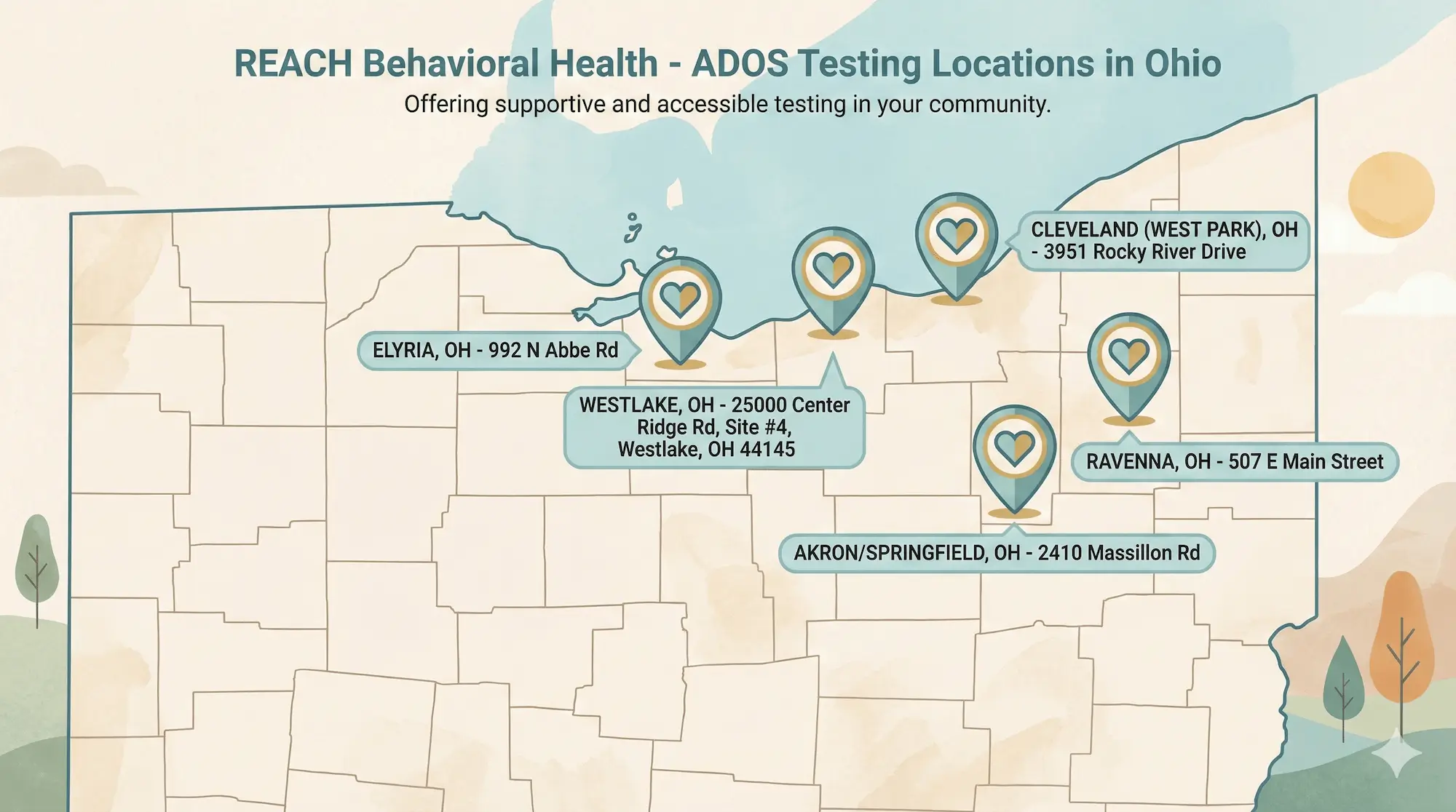
Autism evaluations and ADOS assessments can be arranged through your doctor, a specialist healthcare professional, or school referral – but this route often involves long waitlists or complicated referral processes. If you’d rather not wait, you can book an ADOS assessment directly with centers like REACH, where we offer compassionate and supportive assessments without the complicated referral process or lengthy wait times.
Schedule an ADOS-2 assessment at REACH
Getting answers about autism shouldn’t feel overwhelming.
If you’re ready to take a step towards getting a formal evaluation – whether for yourself or your child – our team is here to support you with clarity, compassion, and care.
At REACH Behavioral Health, we offer:
- Full autism evaluations (including ADOS-2) for children and adults
- No referral required
- No long waitlists
- Insurance support
- A multidisciplinary team – BCBA clinicians, psychiatrists, ABA therapists, and mental-health professionals
- Clear results and personalized next steps
- Ongoing care under one roof – including ABA therapy, counselling, and psychiatric support
- Partnership with EA Schools – access to a specialised Autism Program for school-aged children and teens
And we’ll guide you through every step, so the process feels clear, supportive, and stress-free.
Contact REACH Behavioral Health to begin your autism evaluation.
No referral needed. No long waitlists. Just compassionate, supportive assistance.